Notepad++ plugin
6 SQL dialects
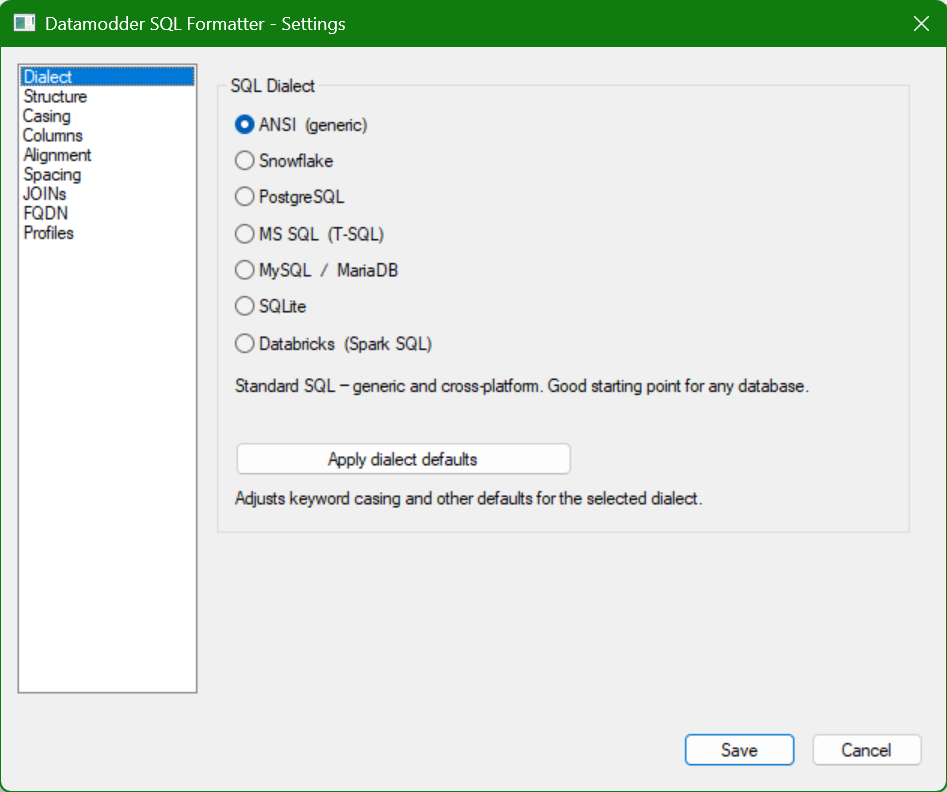
ANSI as a neutral base, plus six concrete dialects — Snowflake, MS SQL (T-SQL), PostgreSQL, MySQL/MariaDB, SQLite and Databricks (Spark SQL). The formatter knows, per dialect, which function name, quote character and date/time syntax is idiomatic, and converts through a central hub so any dialect can reach any other.
Function names that differ per database
NULL replacement is called NVL in Snowflake, ISNULL in T-SQL, and IFNULL in MySQL and Databricks. String length is LENGTH in most dialects, but LEN in T-SQL. The formatter recognizes these function families and rewrites them to the target dialect's equivalent — not a one-to-one text substitution, but a lookup table per dialect pair.
Before
SELECT NVL(discount, 0) AS discount, LENGTH(customer_name) AS name_len
FROM orders
After
SELECT IFNULL(discount, 0) AS discount, LEN(customer_name) AS name_len
FROM orders
One click: idiomatic casing per dialect
On the Dialect tab you pick a dialect and click "Apply dialect defaults" — the formatter immediately applies the casing convention that fits that dialect (for example predominantly uppercase in Snowflake scripts, lowercase in PostgreSQL style). You can then fine-tune the result further on the other tabs.
MS SQL to Snowflake, including date functions
Idiomatic constructs like IIF() and GETDATE() also get their Snowflake counterpart, together with the casing preset that belongs to that dialect.
Before
select iif(amount > 1000, 'large', 'small'), isnull(notes, '-'), getdate()
from orders
After
SELECT IFF(AMOUNT > 1000, 'LARGE', 'SMALL'), NVL(NOTES, '-'), CURRENT_TIMESTAMP
FROM ORDERS
Frequently asked questions
Why isn't ANSI a 'seventh dialect' in the list?
ANSI is the neutral hub form the formatter uses internally to convert from any dialect to any other, and it can itself also be selected as a dialect setting without vendor-specific function names.
What happens to functions with no equivalent?
Functions the formatter doesn't recognize as part of a known dialect family are left exactly as they are — it never guesses.